


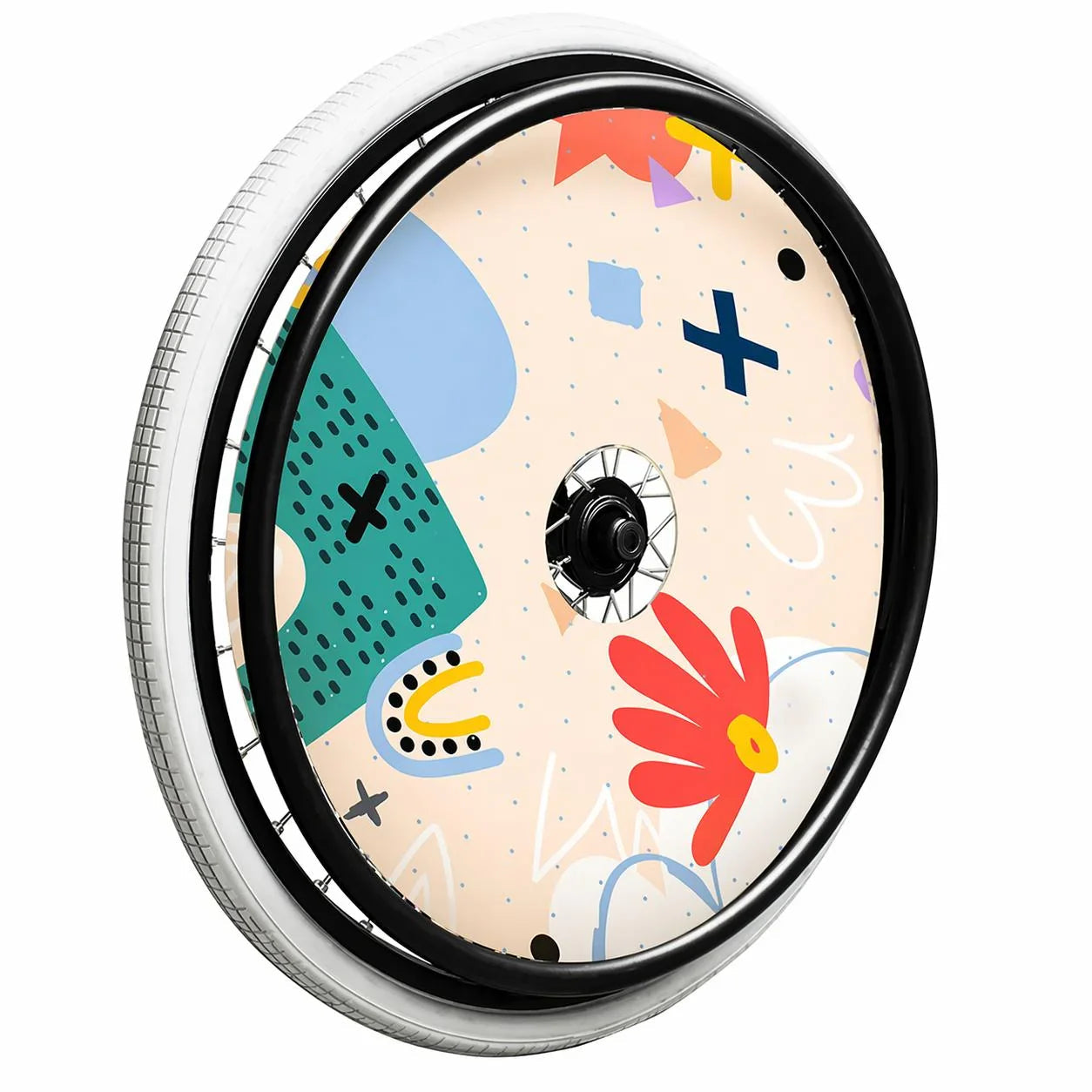
Assistive technology has long focused on solving practical challenges. But for wheelchair users, design goes far beyond function. Every detail, from wheel structure to color, shapes the experience of independence and confidence.
Traditionally, wheelchair accessories like spoke guards were viewed as purely functional. Yet research[1] and user feedback reveal something deeper: personalization and design appeal play a crucial role in safety, acceptance, and long-term use.
Let’s explore why individual design in wheelchair spoke guards matters and why aesthetics and functionality should always work together.
- Where Functionality Meets Aesthetics
- Why Different Types of Wheelchair Spoke Guards Exist?
- Can Design Improve Wheelchair Safety?
- The Psychology of Choice: From Function to Identity
- Why Personalization Leads to Long-Term Use?
- Three Design Principles at Bergh Special Products
- Conclusion: Where Functionality Meets Aesthetics
Why Different Types of Wheelchair Spoke Guards Exist?
The primary purpose of wheelchair spoke guards is to support safe and stable mobility in real-life conditions. But those conditions vary significantly. Wheel types, environments, and user needs vary by individual. That is why no single spoke guard design works equally well for all users.
Different spoke guards are developed with consideration for:
- wheel types (manual or e-drive systems)
- wheel size and configuration
- usage environment, including urban settings, indoor spaces, or active lifestyles
- individual user preferences, including color, transparency, or branding
Because everyday conditions differ, individualized spoke guard solutions perform better. When spoke guards match both the wheelchair and the user’s lifestyle, they are more likely to remain installed and consistency is essential for safety.
Can Design Improve Wheelchair Safety?
Yes. Design improves safety by encouraging consistent use.
Wheelchair spoke protectors are designed to help reduce unwanted interaction with open spokes and to protect wheel structures over time. However, these benefits only exist when spoke guards stay installed during everyday movement.
Safety in assistive technology is not only an engineering issue. It is also behavioral. If a product feels inconvenient, uncomfortable, or visually unsuitable, users may remove it. This is not a technical failure. It is a design failure.
When aesthetics and protection meet, safety becomes part of the overall experience. Well-designed wheelchair spoke guards support safer outcomes by fitting naturally into daily use.
The Psychology of Choice: From Function to Identity
People naturally form emotional connections with the objects they use every day. When a product reflects personal style through color, transparency, or a distinctive finish, it becomes more than a tool. It becomes part of identity.
Market data confirms this shift.
"Functionality alone is no longer enough. Demand is rising not just for basic safety components but also for premium and customizable options." — Intel Market Research 2026
Demand is no longer driven only by basic functionality, but by solutions that combine protection with personal relevance. Customizable spoke guards reflect a broader change in how mobility products are chosen and valued.
Why Personalization Leads to Long-Term Use?
Personalization is far more than decoration. It is about ownership and agency.
Research in accessibility shows that the ability to choose a design directly enhances psychological comfort and confidence in daily mobility. When users feel that a product belongs to them, they are more likely to keep it installed and care for it over time.
This leads to two important effects:
- Higher retention: Users keep guards installed longer
- Consistent protection: Safety benefits remain constant
In this way, aesthetics directly support functionality.
Three Design Principles at Bergh Special Products
At Bergh Special Products, we design wheelchair spoke guards to integrate seamlessly into everyday life. Our approach is built on three core principles:
Visual Appeal
Color options, transparent materials, and printed finishes help spoke guards feel like a natural part of the wheelchair, not a clinical add-on.
Functional Clarity
Protection should be intuitive. Our spoke protectors integrate smoothly into the wheel without interfering with daily performance.
Personal Expression
Custom wheelchair spoke guards allow users, brands, and partners to adapt solutions to specific environments, needs, and identities.
Spoke guards are not just accessories. They are essential wheelchair parts used every day.
Use our wheelchair customizer to design spoke guards that match your style.
Conclusion: Where Functionality Meets Aesthetics
Individual design isn’t a luxury, it’s a necessity.
When aesthetics meet functionality:
- Users keep guards installed longer
- Personalization strengthens confidence and satisfaction
- Long-term protection remains consistent
In the end, wheelchair spoke guards perform best when they’re designed not only to function but to belong.


