


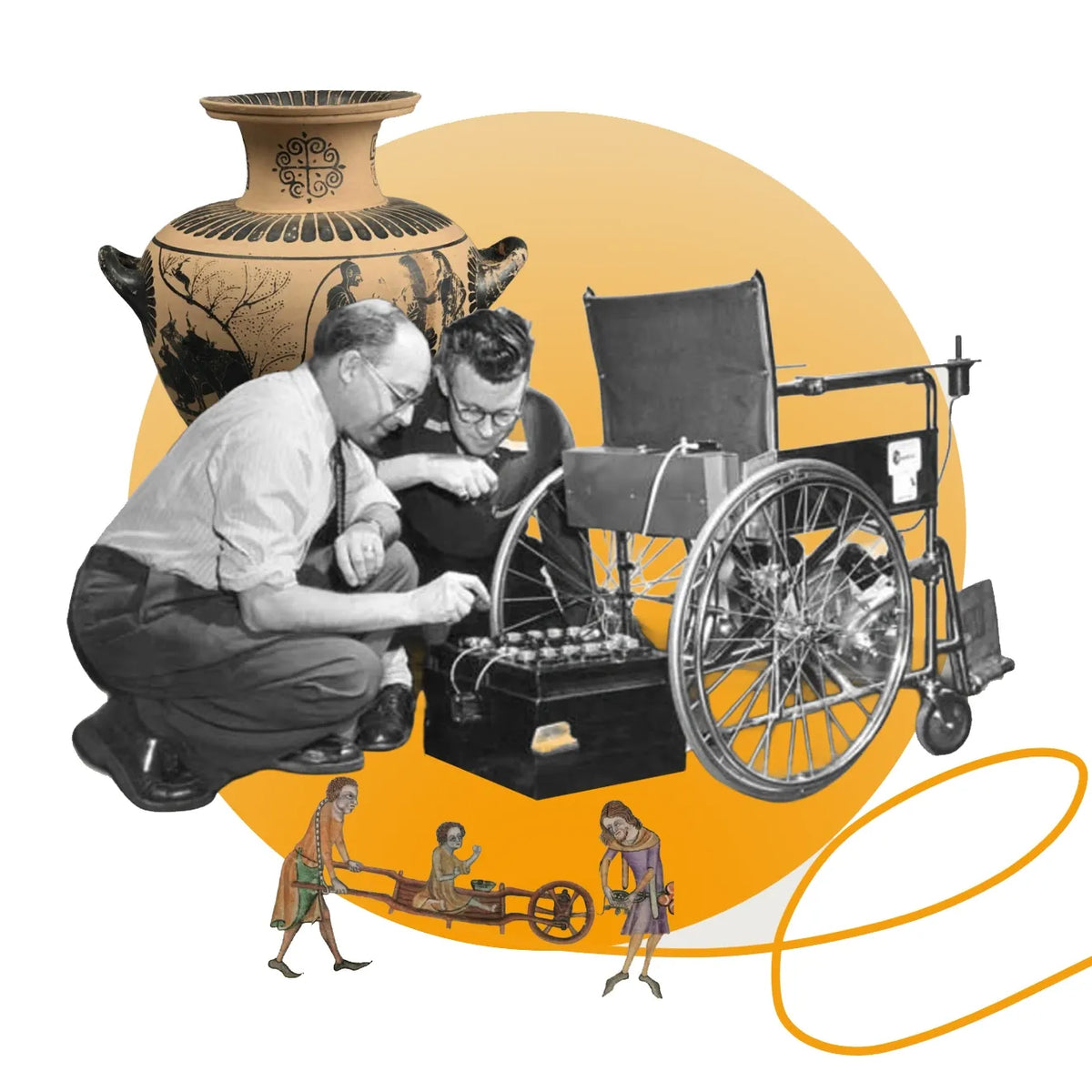
The wheelchair most people know today would be almost unrecognizable to someone living 400 years ago.
What began as a chair pushed by an attendant gradually evolved into equipment designed around the person using it. New ideas improved independence, made travel easier, reduced physical effort, and allowed wheelchairs to be adapted to different lifestyles and activities.
Let's explore the people, inventions, and turning points that shaped wheelchair design over more than two thousand years.

The First Wheelchairs in History
Long before modern wheelchairs existed, people were already finding ways to combine seating with wheels. Some of the earliest surviving examples give us a glimpse of where wheelchair history began.
When were wheelchairs invented?
There isn't one simple answer.
The history of the wheelchair dates back more than 2,500 years. The earliest examples of the ancient wheelchair date back to the 6th and 5th centuries BC. An inscription found on a stone slate in China and a child's bed depicted on a Greek vase provide the first evidence that people were already experimenting with wheeled furniture.

Three centuries later, historical records from China describe what is often referred to as the ancient Chinese wheelchair — wheeled seats used to transport people with disabilities. Historians cannot say with certainty whether these early designs should be considered true wheelchairs, but they represent some of the earliest documented attempts to create mobility solutions for people with limited movement. These early Greek and Chinese designs are often considered the oldest wheelchair evidence discovered by historians, although their exact function is still debated.
Who invented the wheelchair?
Although the inventor of the wheelchair is unknown, the first well-documented wheelchair appeared much later, in 1595, for King Philip II of Spain. During the final years of his life, the king suffered from severe gout, making walking increasingly difficult. An unknown Spanish craftsman built a wheeled chair, often referred to as the "invalid's chair," creating one of the earliest documented medieval wheelchairs, to help King Philip II move around the royal palace.

The chair featured padded upholstery, armrests, leg rests, an adjustable backrest, and four small wheels. It could not be propelled by its user, so attendants pushed it from place to place. Although simple by today's standards, it reflected a growing understanding that mobility equipment could be designed to meet an individual's physical needs.
The next major milestone came in the seventeenth century, when inventors began developing wheelchairs that users could propel themselves.
How People Started Moving Themselves
The next major breakthrough came in 1655, when Stephan Farffler, a clockmaker from Nuremberg, Germany, built what is widely considered the first self-propelled wheelchair. After sustaining a spinal cord injury as a child, Farffler designed a three-wheeled wooden chair powered by hand-operated cranks and gears. For the first time, a wheelchair user could move without relying on an attendant.

Farffler's idea inspired later inventors. During the eighteenth century, John Joseph Merlin developed a more advanced self-propelled design that used gears and cranks to improve movement. His design became so well known that similar wheelchairs were often called "Merlin chairs" and appeared in nineteenth-century medical equipment catalogues for people with gout and other conditions affecting mobility.

The First Popular Wheelchairs
As wheelchairs became more practical, they also became more widely available. One of the best-known examples of the Victorian wheelchair was the Bath chair, developed in the English city of Bath, which attracted visitors seeking treatment in its famous mineral springs.

The first Bath chair appeared around 1750, but the most successful version was designed by John Dawson in 1783. It featured two large wheels, a small front wheel for steering, and a long handle that allowed the passenger to help guide the chair. Even so, an attendant was still needed to push it.
During the nineteenth century, demand for wheelchairs continued to grow. Improvements in manufacturing led to more models becoming available, and by 1909, Sears, Roebuck & Co. offered more than 100 wheelchair models through its catalogue.
The Folding Wheelchair That Changed Everything
One of the biggest milestones in wheelchair history came during the 1930s, when American engineers Herbert Everest and Harry Jennings developed the folding X-frame, one of the most influential 1930s wheelchair designs.

Everest became paraplegic after a mining accident in 1918 and wanted a wheelchair that was lighter, easier to transport, and practical for everyday use. Together with Jennings, he created a folding design that could fit inside a car. Their invention transformed personal mobility and became the foundation for many manual wheelchairs still used today.
From Manual to Electric Wheelchairs
When Was the First Electric Wheelchair Invented?
Wheelchair technology continued to advance throughout the twentieth century. One of the earliest motorized wheelchairs was invented in 1919 by Levitt Luzern Custer to help wounded World War I veterans. During the 1920s, the R.A. Harding Company in England developed an electrically propelled tricycle, marking another step in the evolution of the 1920s wheelchair. The first electric-powered wheelchair to enter production was later created by Canadian engineer George Klein to improve mobility for veterans returning from the Second World War.
The development of powered mobility accelerated during the following decades. In 1950, Sam Duke patented an auxiliary power drive for manual wheelchairs, marking another milestone in 1950s wheelchair innovation and providing additional assistance for people who needed support over longer distances.

By the 1960s, powered wheelchairs were becoming more common. Early systems were heavy and difficult to remove, but they introduced joystick and steering controls that remain common today. During the 1970s, wheelchair design continued to evolve. The 1970s wheelchair featured lighter aluminium frames, making everyday use more practical and easier to propel.
How Sport Changed Wheelchair Design
The 1940s wheelchair became closely linked with rehabilitation after the Second World War, when sport played a major role in wheelchair innovation. Rehabilitation programmes encouraged veterans with spinal cord injuries to take part in physical activity, leading to the development of wheelchair basketball and other adaptive sports.
Athletes needed wheelchairs that were lighter, stronger, and faster. Manufacturers responded with rigid frames, angled wheels, adjustable balance points, and materials such as aluminium and titanium. Many of the features first developed for sport later became standard on everyday active wheelchairs.
Modern Wheelchairs: Technology and Personalization
Today's wheelchairs are designed around the individual. Users can choose different frame sizes, seating systems, wheel configurations, and accessories based on their daily activities, physical needs, and personal preferences. Power-assist systems, alternative controls, sensors, and smart navigation continue to expand mobility.
Personalization has also become an important part of wheelchair design. Accessories such as wheelchair spoke guards, trays, and custom mounting solutions allow wheelchairs to be adapted for work, travel, sport, and everyday life. At BSP, we support this approach by offering custom sizes, shapes, colours, and designs to help users create a wheelchair that fits both their practical needs and personal style.
Conclusion
The history of wheelchairs spans more than 2,500 years of continuous innovation. What began as a simple wheeled chair for assisted transport gradually became equipment that supports work, education, travel, sport, and everyday life.
Throughout wheelchair history, each breakthrough solved a practical challenge, from independent propulsion and folding frames to electric assistance and smart technology. Future innovations will continue to build on that foundation, with a growing focus on adaptability, repairability, and individual needs.
Explore our wheelchair accessories to see how today's mobility solutions can be tailored to your lifestyle.
Sources
Science Museum. The History of the Wheelchair.Wellcome Collection. Historical illustrations and archives. History of Physiotherapy. History of the WheelchairWHILL. The Evolution of Wheelchair Technology. ResearchGate. Historical reference materials on early wheelchair development.Wikimedia Commons.


